

Sanjan Sharma · Founder & Director
Sanjan Sharma is an entrepreneur and technology and digital growth professional with 8+ years of experience across digital marketing, technology, SaaS, education, BFSI, banking, B2B sales and business growth.
LinkedIn lead generation is the only outbound channel where your prospects have volunteered their job title, their employer and their recent thinking. That is an enormous advantage, and most teams throw it away within the first message by treating the platform as a cheaper email list.
The mistakes below are the ones we see repeatedly, in order of how much they cost. None of them are about tooling, because LinkedIn lead generation rarely fails for want of software.
1. Targeting by title instead of by trigger
A filtered search gives you everyone who holds a job title. It does not tell you which of them has a reason to care this month. Consequently a list built on title alone converts at a rate that makes the whole channel look broken, when the problem is only that nobody on it was in the market.
Instead, build around a trigger: a funding round, a new hire in the relevant function, a move to a competitor, a post complaining about the exact thing you fix. LinkedIn lead generation gets dramatically easier when the first line can reference something that actually happened.
Public filings are an underused source of triggers here. The SEC’s EDGAR full-text search will tell you which listed companies have just disclosed a change worth a conversation, months before it reaches the trade press.
2. Spending the connection request on yourself
The connection note is roughly three hundred characters and it is the only part of the sequence the recipient is certain to see. Nevertheless most of them are spent introducing the sender’s company, which is information nobody asked for from a stranger.
Spend it on them instead. Reference the trigger, say in one clause why you are reaching out, and stop. Furthermore, resist attaching a calendar link to a request from someone who has never heard of you; it reliably halves acceptance.
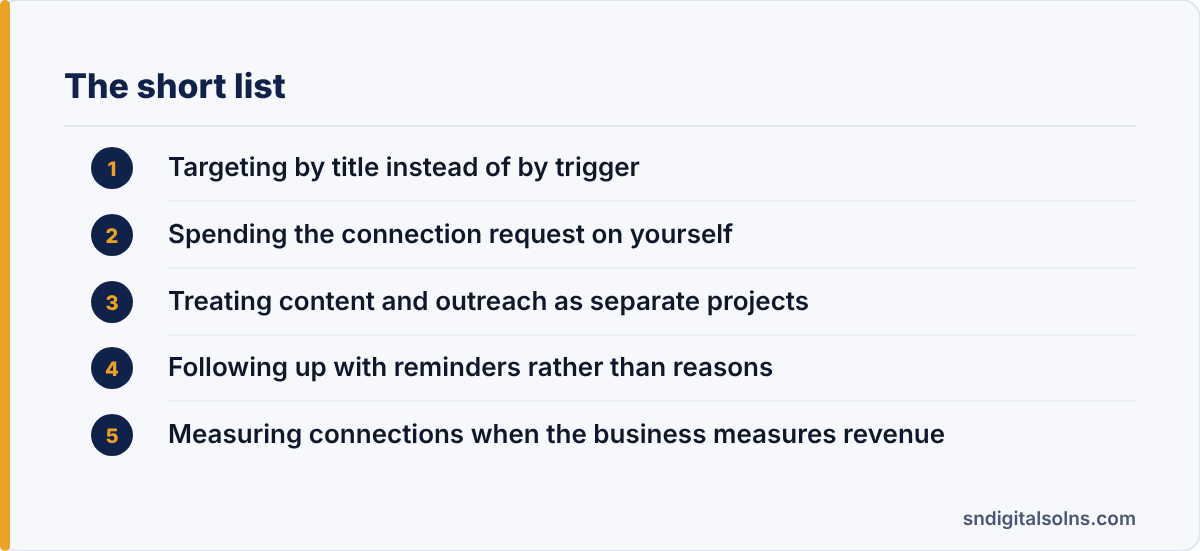
3. Treating content and outreach as separate projects
This is the expensive one. When a prospect gets your message, the first thing most of them do is look at your profile and your recent posts. If those are empty, or are reposted industry news, the message has to carry the entire burden of credibility.
Therefore the cheapest improvement to LinkedIn lead generation is usually not a better sequence, it is publishing something specific and useful once a week under the name that is doing the outreach. The outreach then lands on a profile that has already answered the question of whether you know anything.
4. Following up with reminders rather than reasons
A follow-up that says “just circling back” tells the recipient you have nothing new, so there is no reason to reply this time either. However a follow-up carrying a genuinely relevant link, a short observation about their market, or an answer to a question they raised publicly is a different message entirely.
Plan three to four touches with something new in each. In short, if you cannot think of anything to add, that is information: the prospect was probably not a fit, and the slot is better spent elsewhere.
5. Measuring connections when the business measures revenue
In LinkedIn lead generation, acceptance rate is easy to move and tells you almost nothing. Meanwhile the numbers that decide whether LinkedIn lead generation survives the next budget review are positive reply rate, meetings held, and pipeline value by source.
Track those from the first week, even when the volumes are small and the percentages look unstable. Teams that start measuring properly only after the channel is questioned never have the history to defend it.
What good LinkedIn lead generation looks like after ninety days
Good LinkedIn lead generation at that point looks realistic rather than impressive: a tightly defined list rebuilt monthly around triggers, twenty to thirty requests a day from one warm account, a weekly post from the same person, a four-touch sequence written by a human, and a reply rate somewhere between five and twelve per cent. That is unglamorous and it compounds.
As a reference point, the four LinkedIn accounts we run outbound from produced 1,086 replies and 370 booked sales calls, which is the ratio to plan against rather than a connection count.
What it is not is a thousand connections a week. For the sequencing and the content working together, our B2B lead generation service covers both, and our piece on the hard rules for LinkedIn automation tools explains where software genuinely helps.