

Sanjan Sharma · Founder & Director
Sanjan Sharma is an entrepreneur and technology and digital growth professional with 8+ years of experience across digital marketing, technology, SaaS, education, BFSI, banking, B2B sales and business growth.
LinkedIn lead generation tools fall into four categories that are routinely confused with one another, and buying the wrong category is the most common and most expensive mistake in this market. A sequencer will not fix bad data. An enrichment provider will not book a meeting.
Here is how the categories actually divide, and the four rules we use to decide what a team genuinely needs before anything is purchased.
1. Know which of the four problems you are solving
LinkedIn lead generation tools divide cleanly once you look at them this way. Sequencers send and follow up on a schedule. Enrichment providers turn a profile into a verified email address and a phone number. Trigger and intent tools tell you who is worth contacting this week. Reporting layers connect all of it to revenue.
Most teams buy a sequencer first because it demonstrates best, then discover their real constraint was the list. Consequently the first rule is to name the bottleneck out loud before looking at any of the LinkedIn lead generation tools on the market.
2. Buy enrichment on accuracy, not on database size
Every provider claims hundreds of millions of contacts. That number is close to meaningless, because coverage in your specific market is what determines whether the tool is useful, and it varies enormously by country and company size.
Therefore test with your own list. Take a hundred real prospects, run them through each trial, and measure match rate and bounce rate yourself. Moreover, check the lawful basis for the data where you operate; in Europe that means reading Article 6 of the GDPR rather than trusting a compliance badge on a pricing page.
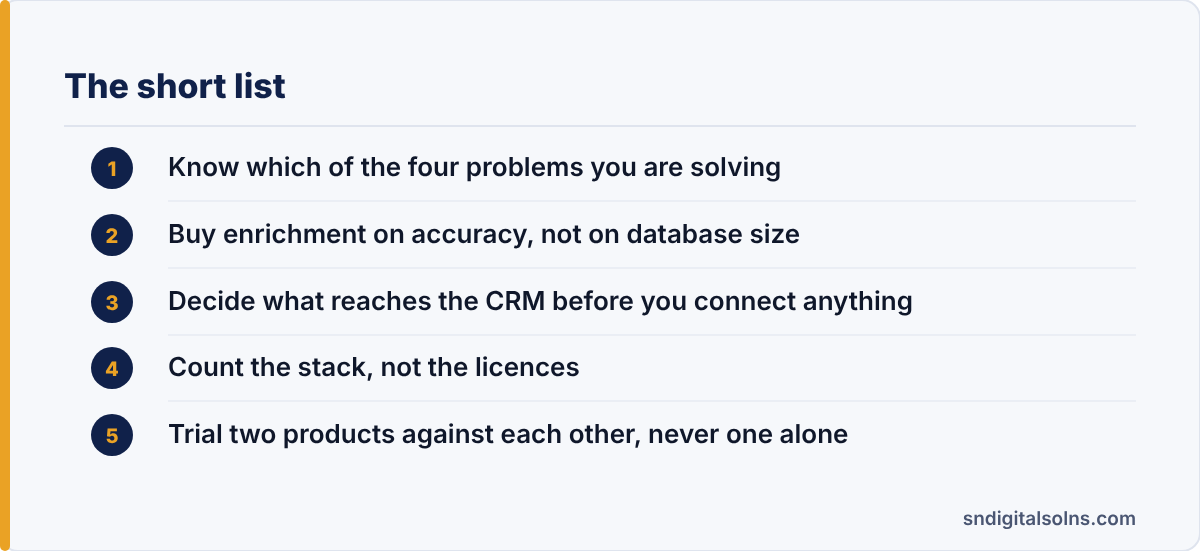
3. Decide what reaches the CRM before you connect anything
Left to their defaults, LinkedIn lead generation tools will write a record for every accepted connection and every enriched contact. Within a quarter the CRM holds tens of thousands of people, reporting becomes unusable, and per-seat costs rise for data nobody wanted.
So set the rule first: a contact reaches the CRM on a positive reply, with the message thread attached. Everything before that stays in the tool. In short, the CRM is for conversations, not for a copy of the internet.
4. Count the stack, not the licences
A typical stack of LinkedIn lead generation tools ends up with Sales Navigator, a sequencer, an enrichment provider and sometimes an intent tool, each billed per seat. Three seats across four products is a substantial annual commitment, and it is rarely presented as one number.
Add it up and divide by meetings held last quarter. If the result is uncomfortable, the answer is usually to drop a category rather than negotiate a discount. Similarly, review it every six months, because these stacks accumulate quietly.
5. Trial two products against each other, never one alone
A single trial always looks impressive, because you have nothing to compare it with and the onboarding is designed to produce an early win. Running two shortlisted LinkedIn lead generation tools side by side on the same list for two weeks costs very little and settles the question properly.
Split the list evenly, keep the message identical, and compare match rate, deliverability and how much manual work each one still demanded. In our experience the winner is rarely the one that demonstrated best, because demos optimise for the first ten minutes rather than the fiftieth hour.
The smallest set of LinkedIn lead generation tools that works
For most teams under twenty people: Sales Navigator for the list, one browser-based sequencer with conservative limits, one enrichment provider tested on your own data, and your existing CRM. That is it. The intent layer earns its place only when you are already contacting everyone obvious.
For a sense of what a modest stack actually produces, our four LinkedIn outbound accounts booked 370 sales calls from 5,076 invitations.
Anything beyond that is usually buying around a positioning problem. If you want the stack designed against a real pipeline, our B2B lead generation service covers it, and the four tests for a LinkedIn outreach tool apply to whichever sequencer you shortlist.