

Sanjan Sharma · Founder & Director
Sanjan Sharma is an entrepreneur and technology and digital growth professional with 8+ years of experience across digital marketing, technology, SaaS, education, BFSI, banking, B2B sales and business growth.
LinkedIn prospecting is unusual among outbound channels because the prospect can see exactly how much effort you put in. Your profile, your last post and the shape of your message all arrive together, and all three are judged in about four seconds.
That is why volume tactics decay faster here than anywhere else, and why these six rules are worth more than any tool.
1. Fix the profile before you start LinkedIn prospecting
Every person you contact through LinkedIn prospecting looks at your profile before replying, so it is the landing page for the whole channel. A headline describing your job title tells them nothing; a headline describing who you help and with what tells them whether to bother.
So rewrite the headline, the about section and the featured links first. Moreover, this costs an hour once and improves the reply rate of every message you will ever send.
2. Earn the connection before the pitch
A connection request followed immediately by a sales message is the single most common LinkedIn prospecting mistake, and it is why most people now ignore requests from strangers altogether.
Therefore leave a gap. Connect with a short, specific note, let a few days pass, and open with something that is true about them rather than about you. Consequently the reply rate rises and the block rate falls, which matters because blocks compound.
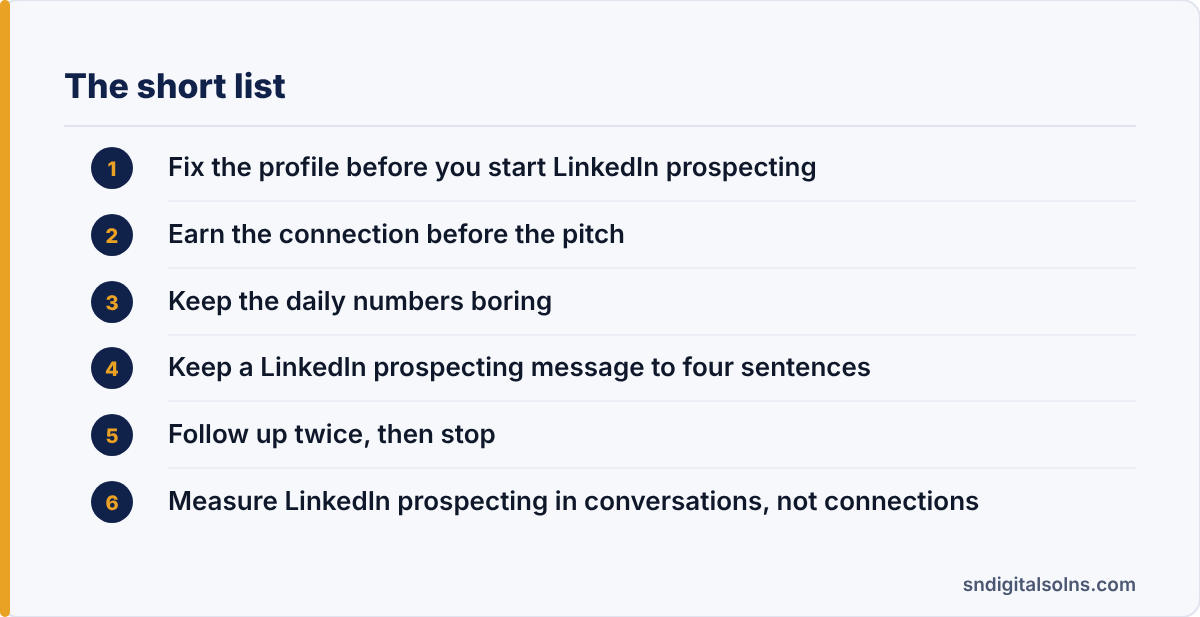
3. Keep the daily numbers boring
LinkedIn restricts LinkedIn prospecting accounts that behave mechanically, and a restriction on a founder’s personal account is an expensive way to learn that. However the bigger cost is reputational: the people who saw the burst remember it.
So keep invitations modest and consistent rather than batched, vary the timing, and never run LinkedIn prospecting from an account you cannot afford to lose. In short, treat the daily ceiling as a feature of the channel, not an obstacle to it.
4. Keep a LinkedIn prospecting message to four sentences
Long first messages are read as broadcasts regardless of how personal they are, because the length itself signals a template. Four sentences: why them specifically, what you noticed, what you do in one line, and a question that is easy to answer.
Furthermore, ask a question they can answer in five words. A request for thirty minutes asks for a decision; a question asks for a reply, and replies are what you are actually collecting.
5. Follow up twice, then stop
Nevertheless the discipline most teams lack is stopping. Two follow-ups spaced a week apart capture nearly everyone who was going to respond. A fourth and fifth message converts almost nobody and reliably converts a neutral prospect into one who will never reply.
Because the list is finite and the market is small, protecting the people who said nothing matters more in LinkedIn prospecting than squeezing the last reply from them.
6. Measure LinkedIn prospecting in conversations, not connections
Connection count is the vanity number of LinkedIn prospecting. It rises steadily whatever you do and tells you nothing about whether the market is interested.
Track conversations held per hundred connections instead, and opportunities per hundred conversations a quarter later. Those two figures tell you whether LinkedIn prospecting is working while there is still time to change it.
When this channel is the wrong one
Linkedin prospecting is the wrong channel in three situations. If your buyers are plant managers, site foremen or anyone whose work is not done at a desk, it will under-perform the phone badly. If you sell to a few hundred accounts, pick up the phone. And if your profile still describes a previous job, fix that before spending a day on sequences.
For the ratios a disciplined programme produces, our four LinkedIn outbound accounts turned 5,076 invitations into 1,255 connections, 1,086 replies and 370 booked sales calls.
The rules you are operating under are in LinkedIn’s own user agreement, which is worth reading before buying any tool. Our B2B lead generation service runs this channel for clients, and how to judge LinkedIn automation tools covers the software side.