

S N Digital Solns · Software development, digital marketing and PR
The S N Digital Solns team builds software and websites, generates demand and runs PR for clients across the United States, Canada, Australia, the UAE, Saudi Arabia and India.
A LinkedIn connection request is the smallest piece of outbound there is, and the one most people get wrong, because it feels too trivial to think about. It is read in about four seconds alongside your photo, your headline and whether you have anything in common.
These seven rules come from running this channel at volume and watching which requests get accepted and which get reported.
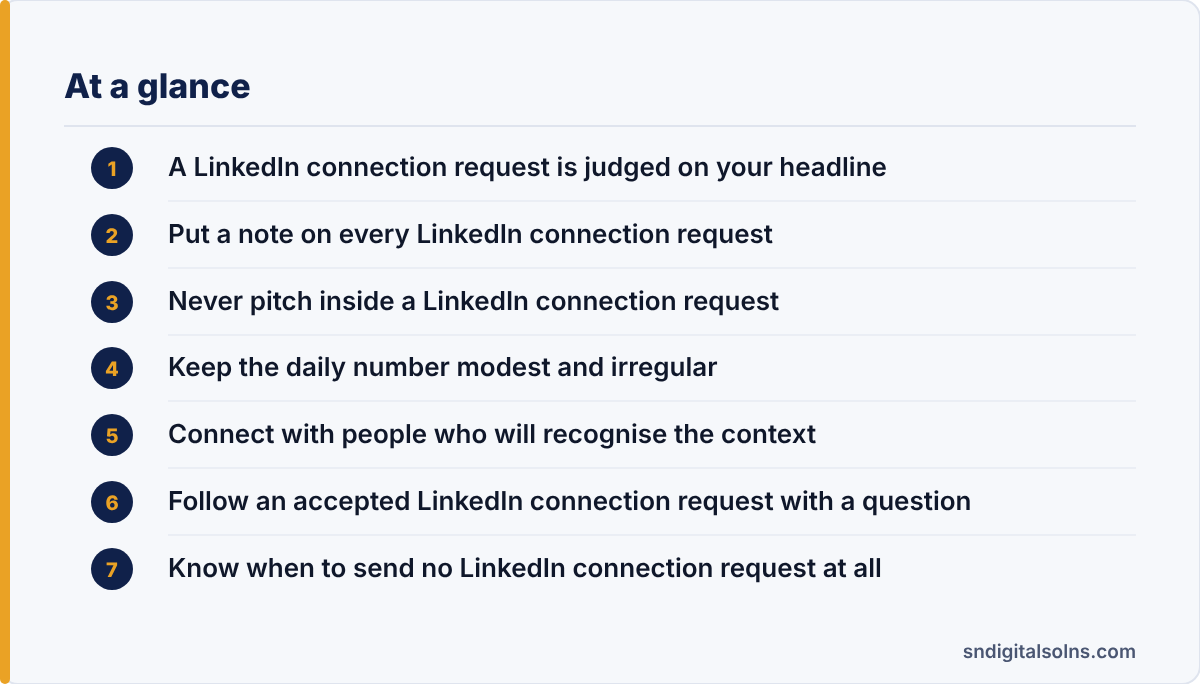
1. A LinkedIn connection request is judged on your headline
Before reading the note on a LinkedIn connection request, the person reads your name, photo and headline. A headline that states a job title gives them nothing to accept on; one that states who you help and with what gives them a reason.
So fix the headline before sending anything. Moreover, it is the single change that improves acceptance across every request you will ever send, and it takes ten minutes.
2. Put a note on every LinkedIn connection request
A blank LinkedIn connection request from a stranger is accepted mostly by people collecting connections. However a long note is worse, because length signals a template and a template signals a pitch.
Therefore write one sentence that is true about them and one about why you are connecting. Consequently the note reads as a person rather than a campaign, which is the entire objective.
3. Never pitch inside a LinkedIn connection request
The fastest way to be ignored permanently is to sell in the first eighty characters. The request becomes a cold advertisement, and most people now treat any LinkedIn connection request containing a product name as spam before reading it.
So separate the two moments: connect for a reason, then let several days pass before any conversation about what you do.
4. Keep the daily number modest and irregular
LinkedIn restricts accounts whose LinkedIn connection request pattern looks mechanical, and a restriction on a founder’s account is an expensive lesson. Nevertheless the bigger risk is the withdrawal rate: too many ignored requests and the account gets limited regardless of volume.
Withdraw unanswered requests after three weeks to keep that ratio healthy, and vary both the daily count and the time of day.
5. Connect with people who will recognise the context
Acceptance rates rise sharply when you share a group, a former employer, an event or a mutual connection, because the person has something to place you against. A LinkedIn connection request into complete unfamiliarity is the hardest version of the job.
Furthermore, this is a list-building instruction rather than a copywriting one. Build the list from events attended, groups joined and companies in your existing network’s orbit first.
6. Follow an accepted LinkedIn connection request with a question
An accepted LinkedIn connection request is permission for a conversation, not for a presentation. Open with a question they can answer in five words, about something they said or published.
In short, you are collecting replies, not booking meetings, and the meeting comes from the reply if there is one to be had.
7. Know when to send no LinkedIn connection request at all
If the person is a plant manager, a site foreman or anyone whose job is not done at a desk, LinkedIn will under-perform a phone call badly. If they have posted nothing in two years, the account is dormant and your request will sit unread.
And if you cannot write a true first sentence about them in under a minute, the account does not belong on the list yet. Because the research is the work, a request you cannot personalise is evidence the targeting needs another pass.
What good looks like
An acceptance rate you can live with, a withdrawal habit that keeps the ratio clean, and replies rather than connections as the number you report. For the ratios involved, our four LinkedIn outbound accounts turned 5,076 invitations into 1,255 connections and 1,086 replies.
The limits you are working inside are set out in LinkedIn’s own user agreement. Our B2B lead generation service runs this channel for clients, and how to judge a LinkedIn outreach tool covers the software that automates it.