

Sanjan Sharma · Founder & Director
Sanjan Sharma is an entrepreneur and technology and digital growth professional with 8+ years of experience across digital marketing, technology, SaaS, education, BFSI, banking, B2B sales and business growth.
LinkedIn lead generation ads are the most expensive way to reach a B2B audience and, used carelessly, the easiest way to generate a list of people who will never answer the phone. The targeting genuinely is better than anywhere else. The temptation it creates is the problem.
Four traps account for most of the money wasted on LinkedIn lead generation ads, and all four are design decisions rather than bidding mistakes.
1. The native form that removes all the friction
Lead gen forms pre-fill from the member’s profile, so a prospect can submit in two taps without typing anything or leaving the feed. Consequently your cost per lead falls immediately, which is why the format is recommended so enthusiastically.
However the friction you removed was also the qualification. A two-tap submission from someone who did not read the offer is indistinguishable, in the export, from a genuine enquiry. In our experience LinkedIn lead generation ads using native forms produce two to three times the volume at a fraction of the contact rate.
2. Offering a download when the buyer wanted an answer
Most LinkedIn lead generation ads offer a guide, a report or a whitepaper, because that is what converts cheaply. The trouble is that wanting a PDF and wanting a supplier are different intentions, and the gap between them is where nurture budgets disappear.
Therefore test an offer that only a buyer would accept: an assessment, a teardown of their current setup, a pricing conversation, a working session. The cost per lead will look considerably worse and the pipeline will usually look considerably better.
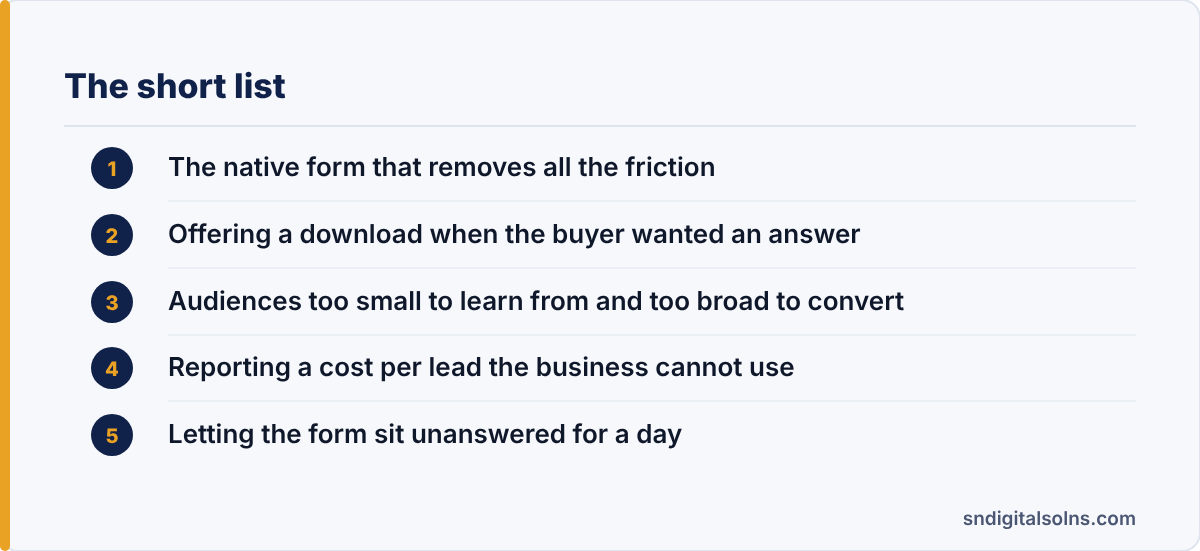
3. Audiences too small to learn from and too broad to convert
LinkedIn enforces a minimum audience size, and B2B targeting narrow enough to be genuinely relevant often falls below it. The usual response is to loosen a filter until the campaign runs, at which point you are paying premium rates to reach people who do not qualify.
Instead, widen deliberately rather than accidentally. Add adjacent job functions you can actually serve, or add countries, rather than dropping the seniority filter. Moreover, remember that a campaign spending a few hundred dollars a month will take months to produce a statistically meaningful result at these prices.
4. Reporting a cost per lead the business cannot use
The platform reports cost per lead, so that is the number that reaches the board. It is also the number LinkedIn lead generation ads are best at flattering. Without connecting submissions to the customer record, nobody can tell whether a cheap lead was a cheap customer or a wasted hour.
So pass a source parameter through to the CRM from the first day, and report cost per meeting held and cost per opportunity alongside cost per lead. Similarly, check the compliance footing of what you collect; the FTC’s privacy and security guidance for business is the plain-language starting point in the US.
5. Letting the form sit unanswered for a day
A native form submission arrives while the person is still in the feed, thinking about your offer for perhaps thirty seconds. Replying the following afternoon reaches someone who has forgotten submitting anything, which is why so many of these leads are recorded as unreachable.
Accordingly, route submissions straight into whatever your team watches, with an owner and a response time attached. The single highest-return change most advertisers can make to LinkedIn lead generation ads is answering within the hour rather than redesigning the creative.
Where LinkedIn lead generation ads genuinely earn their price
They are excellent at reaching a named list of accounts you cannot otherwise get in front of, at warming an audience before outbound rather than replacing it, and at retargeting people who already visited a specific page. In each of those cases the premium buys precision you cannot get elsewhere.
Organic outbound is the comparison worth making before committing budget to LinkedIn lead generation ads: our four LinkedIn accounts booked 370 sales calls without advertising spend.
They are a poor substitute for a reason to buy. If you want the paid and organic sides sequenced together, our B2B lead generation service covers it, and our piece on the costly mistakes in LinkedIn lead generation covers the organic half.