

Sanjan Sharma · Founder & Director
Sanjan Sharma is an entrepreneur and technology and digital growth professional with 8+ years of experience across digital marketing, technology, SaaS, education, BFSI, banking, B2B sales and business growth.
B2B appointment setting services are sold on a single number: meetings per month. That number is trivially easy to hit and tells you almost nothing about whether the engagement will produce revenue, which is why so many of them end badly at month four.
These four tests take an hour and they separate providers who will protect your pipeline from providers who will fill your diary.
1. Test the pricing model before the price
Paying per appointment sounds like buying an outcome. In practice it creates an incentive to book anyone who will accept, and the people booking respond to that incentive exactly as you would expect.
Consequently the better structures are a retainer with a qualified-meeting target, or a per-meeting fee that only applies once your rep has held and accepted the call. Any provider of B2B appointment setting services who refuses a quality gate is telling you which number they intend to optimise.
2. Find out who is actually on the phone
Ask how many accounts each caller handles simultaneously. Someone carrying twelve clients cannot know your market, and the first sceptical question from a prospect will prove it within thirty seconds.
Moreover, ask to listen to three recorded calls from a comparable client, redacted. Good B2B appointment setting services will have these ready and will be pleased to play them. Reluctance here is the single most reliable warning sign in the whole evaluation.
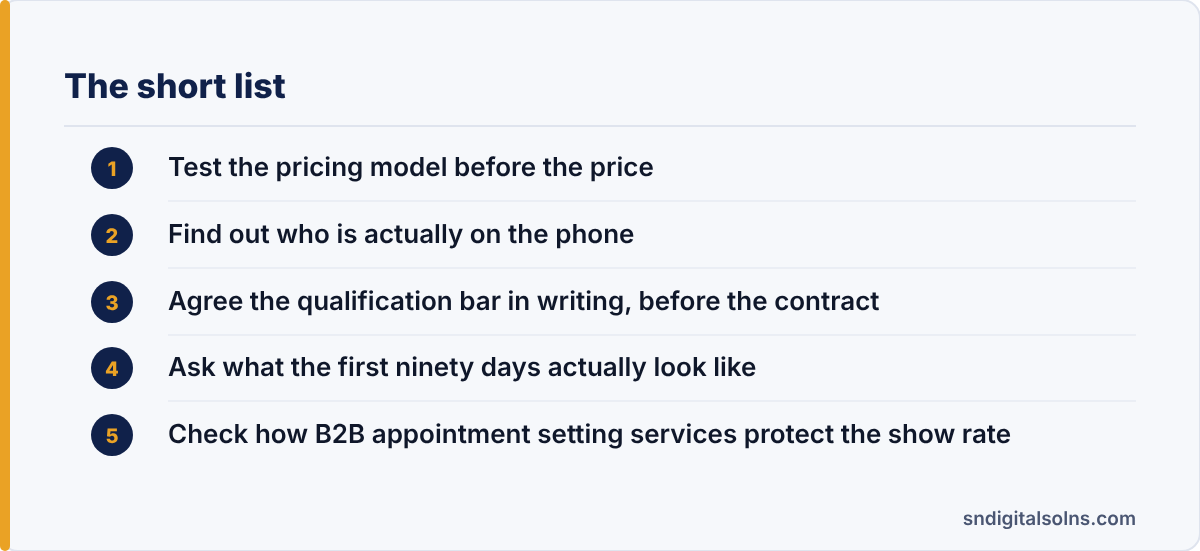
3. Agree the qualification bar in writing, before the contract
Most disputes with B2B appointment setting services are really arguments about what counted as a meeting, conducted after the invoice has arrived. Write the definition down first: the function, the company profile, a problem stated out loud, and a reason it matters this quarter.
Then agree the rejection process. Your rep should be able to reject a meeting with a reason, and both sides should review the rejections fortnightly rather than individually. In short, settle it while everyone is still being polite.
4. Ask what the first ninety days actually look like
Competent B2B appointment setting services spend the first month on positioning, list building, script development and training, and book relatively little. A provider delivering full volume in week two is working from a generic list and a generic pitch.
Therefore ask for the ninety-day plan in writing and treat a slow, specific one as the good sign it is. Similarly, ask what notice period applies and whether the contact data and call records come with you when it ends.
5. Check how B2B appointment setting services protect the show rate
Between twenty and forty per cent of booked meetings never happen, and that range decides the economics of the whole arrangement. A provider booking thirty meetings at a sixty per cent show rate is beaten comfortably by one booking twenty at ninety.
So ask what they do between the booking and the call: a same-day confirmation, a reminder on the morning, a calendar invitation stating what will be covered, and a named person to reschedule with. Providers who have never been asked this will say the show rate is your side of the line, which is itself an answer.
What these tests cannot tell you
No B2B appointment setting services can fix a weak offer or a sales team that takes two days to follow up a meeting request. Outsourced calling scales whatever you already have, including the parts that are not working, and it does so at a cost per meeting that makes the flaws expensive.
For a worked example of the ratios, our four LinkedIn outbound accounts booked 370 sales calls from 1,086 replies.
Before commissioning anything, check that your own close rate on inbound meetings is acceptable. For the rules on who you may call in the US, the FTC’s Telemarketing Sales Rule guidance is the plain-language source. Our B2B lead generation service covers the pipeline around the calling, and the five rules for appointment setting explain what good looks like internally.