

Sanjan Sharma · Founder & Director
Sanjan Sharma is an entrepreneur and technology and digital growth professional with 8+ years of experience across digital marketing, technology, SaaS, education, BFSI, banking, B2B sales and business growth.
Commercial real estate lead generation breaks most marketing advice because the buying cycle is measured in years. A tenant on a ten-year lease is not in the market, until suddenly they are, and whoever they think of in that month wins a mandate worth more than a year of advertising. Nothing about that rewards campaigns designed to capture demand this week.
So the goal of commercial real estate lead generation is not to generate enquiries. It is to be the obvious call when the cycle turns, and to know roughly when it will turn for the owners and occupiers in your patch.
1. In commercial real estate lead generation, the list beats the funnel
In most sectors the marketing asset is a pipeline. In commercial real estate it is a list: every owner, occupier and investor in your submarket, with their lease expiry, their debt maturity, and who makes the decision.
Building that list is unglamorous and almost impossible to replicate, which is exactly why it works. Lease expiries are the single best timing signal available, because they tell you when someone will need advice, which is far more useful than knowing they clicked something.
Marketing against that list is simple. Reach the same people repeatedly with something worth reading, for years, so that the name is already familiar when the decision arrives.
2. Publish the data nobody else will
Generic content does nothing for commercial real estate lead generation. Your prospects are professionals who already understand the market. What they cannot get easily is current, specific, local numbers: what space actually traded at, which way incentives are moving, what a particular submarket’s vacancy really is once sublease space is counted.
A quarterly submarket note with real figures is the most reliable commercial real estate lead generation asset a brokerage can own. It gets forwarded internally, which puts you in front of people you were never introduced to, and it demonstrates the thing clients are actually buying, which is judgement about a specific place.
If you cannot source the numbers, do not invent or round them into something more impressive. This audience checks, and being caught once ends the relationship permanently.
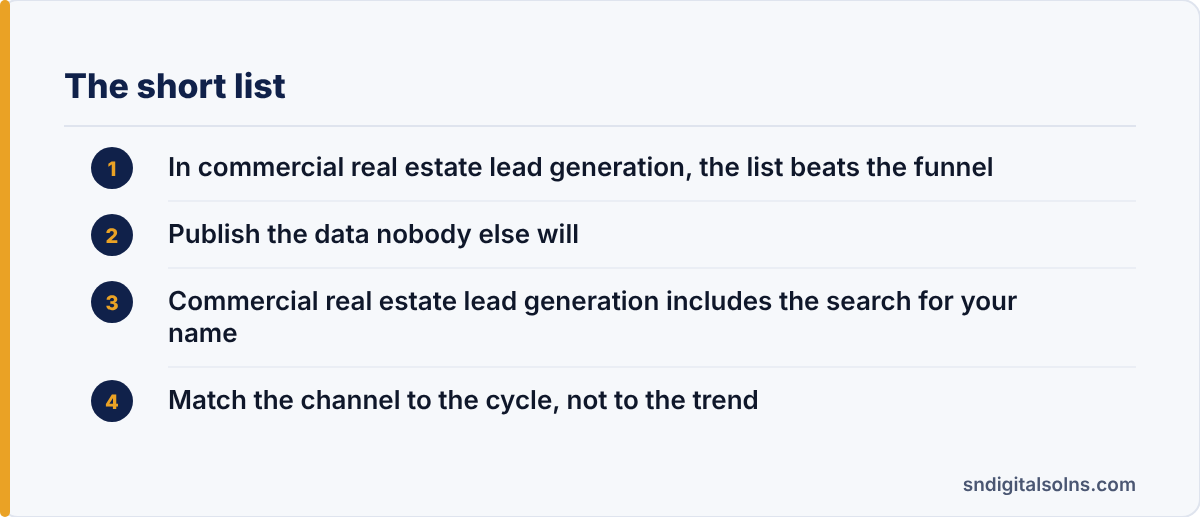
3. Commercial real estate lead generation includes the search for your name
Most commercial real estate instructions involve a committee. The person who met you at a viewing is not the only one deciding, and the others will look you up. What they find should confirm you are a specialist in that asset class and that geography, not a general brokerage with a page about everything.
This is where most firms lose quietly. A deals page that stops two years ago, a team page missing half the people, and no sign of the submarket you claim to dominate all read as decline, whether or not that is true.
4. Match the channel to the cycle, not to the trend
Paid search works for a narrow slice of this market. The United States Census Bureau’s new residential construction series is a better early indicator of where activity is heading than any advertising dashboard, and it is free. Paid search reaches mostly occupiers searching for space right now, and it is expensive because every broker bids on it. It will not reach an owner who might sell next year, because that owner is not searching for anything.
Reaching them is a slower mix: the submarket note, a presence where they already are, and the discipline to keep appearing in front of the same list long after it feels pointless. Commercial real estate lead generation rewards persistence more than cleverness, which is why so few firms do it properly.
Measuring commercial real estate lead generation instead of counting leads
Counting enquiries will tell you almost nothing in a sector with this cycle length. Track list coverage, meaning what share of the owners and occupiers in your submarket you can actually reach. Track how many of them open the note. Track pitch invitations, since that is the real conversion event. And track how often an invitation came from someone you had never personally met, because that number is the clearest evidence the marketing is working.
If you want this run as a system, our B2B lead generation service is built around exactly this kind of long cycle, and our note on telling a real lead generation company from a reseller is worth reading before appointing anyone.