

Sanjan Sharma · Founder & Director
Sanjan Sharma is an entrepreneur and technology and digital growth professional with 8+ years of experience across digital marketing, technology, SaaS, education, BFSI, banking, B2B sales and business growth.
Hiring a demand generation agency is one of the few marketing decisions where the first six months look identical whether the work is excellent or worthless. Traffic rises either way, so the usual dashboard tells you nothing.
These six tests take an afternoon and they separate the firms that will build a pipeline from the firms that will build a report.
1. Ask a demand generation agency what counts as a lead
Every demand generation agency has a definition, and most will not volunteer it. A whitepaper download from a student counts as a lead under one definition and as nothing under another, yet both appear on the same chart.
So make them write it down in the proposal: the job titles that qualify, the company sizes, the markets, and what disqualifies. Moreover, insist the same definition survives into month six, because the quietest way to miss a target is to widen the definition and keep the number.
2. Test their attribution honestly
Ask the demand generation agency how it will attribute a deal that touched a LinkedIn ad in March, a webinar in May and a sales call in July. A good demand generation agency answers with a model and its weaknesses. A weak one answers that their platform handles it.
However the deeper question is what happens when attribution disagrees with the sales team. Therefore ask directly: when your CRM says one thing and their dashboard says another, whose number goes in the board pack? If they have not thought about it, you will be having that argument in month four.
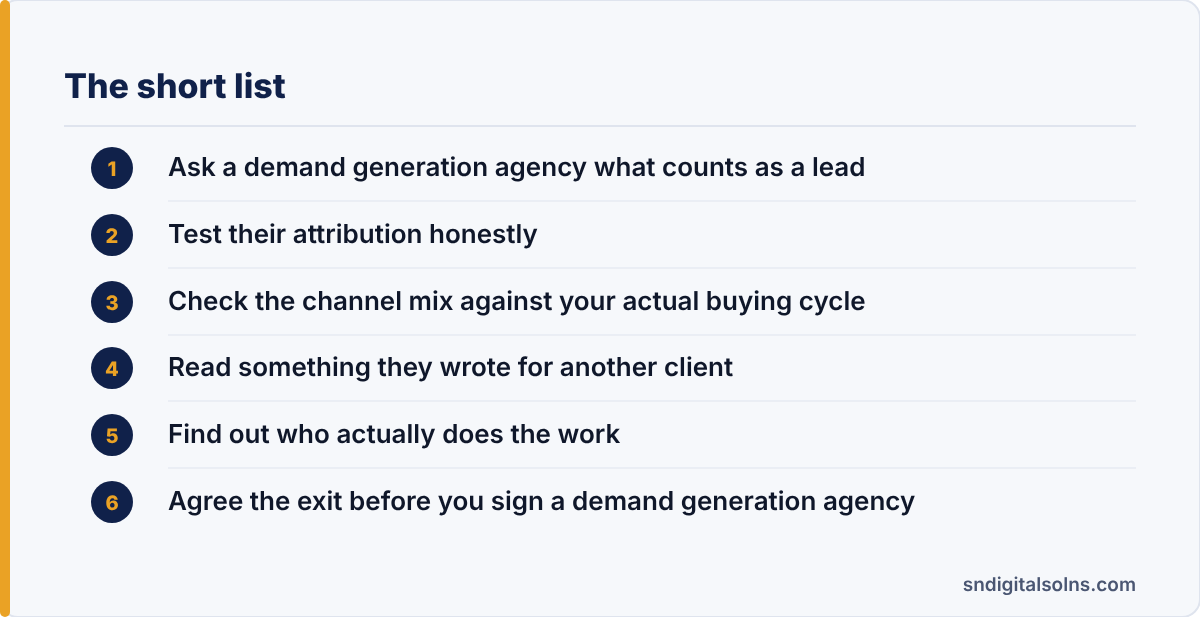
3. Check the channel mix against your actual buying cycle
Short cycles reward paid search and retargeting. Long, committee-led cycles reward content, events and outbound, because the buyer is not in the market on the day your ad runs. Consequently a demand generation agency that proposes the same mix to every client is proposing its own convenience.
Ask them which channel they would cut first if the budget halved, and why. The answer reveals whether they understand your cycle or their own margins.
4. Read something they wrote for another client
A demand generation agency runs on content, and content is where the quality gap is widest and easiest to see. Ask for three pieces written for clients in the last year, not a case study about the pieces.
Read them as a buyer would. In short, if you would not finish the article, neither will your market, and no amount of distribution budget fixes that.
5. Find out who actually does the work
At a demand generation agency the people in the pitch are frequently not the people on the account. This is not dishonest by itself, but it becomes a problem when nobody says so. Ask for the names, the seniority and the hours per week of the team who will run it, and ask how many other accounts each of them carries.
Furthermore, ask what happens when that person leaves. A demand generation agency with a real answer has documentation; one without has a single person holding your programme in their head.
6. Agree the exit before you sign a demand generation agency
Nevertheless the test most people skip is the unglamorous one. Who owns the ad accounts, the tracking, the content, the lists and the landing pages when the contract ends?
Get it in writing that you own all of it and that it transfers within thirty days. A demand generation agency that resists this is telling you how it intends to retain you, and it is not by doing good work.
What a fair first engagement looks like
A fair first engagement with a demand generation agency is ninety days, one clearly stated pipeline target, a weekly number rather than a monthly report, and a break clause. Anything demanding a twelve-month lock before a single result has been produced is asking you to carry all of the risk.
For a sense of what a measured outbound programme produces, our four LinkedIn outbound accounts turned 1,086 replies into 370 booked sales calls, with the counting rules stated.
On the compliance side, the FTC’s privacy and security guidance is the plain-language source for what you may do with the data a programme collects. Our B2B lead generation service covers the pipeline itself, and how to spot a real lead generation company applies the same scepticism one layer down.