

Sanjan Sharma · Founder & Director
Sanjan Sharma is an entrepreneur and technology and digital growth professional with 8+ years of experience across digital marketing, technology, SaaS, education, BFSI, banking, B2B sales and business growth.
Appointment setting is the one part of a sales process that can be made to look successful while destroying the pipeline underneath it. Meetings are easy to book if nobody checks whether the person should have been in the diary.
These are the five rules we apply, and the reason most programmes fail the second one within a month of starting.
1. Define the meeting before you count it
A meeting with someone who cannot buy, has no budget cycle in the next year and agreed mainly to end the call is not a result, yet it appears identically in the report. Consequently the first thing to write down is what qualifies as a meeting worth counting.
Make it specific: the right function, a named problem they said out loud, and a reason it matters this quarter. Everything below that bar still happens, but it goes in a separate column, because mixing the two makes appointment setting impossible to manage.
2. Never pay per meeting without a quality gate
This is where most outsourced appointment setting breaks. Paying per appointment creates an incentive to book anybody, and the people doing the booking are rational. Within weeks the diary fills with meetings nobody wanted and the sales team stops trusting the source.
Therefore tie payment to a meeting that was held and accepted by the rep, not to one that was booked. Moreover, give the rep a documented right to reject, with a reason, and review the rejections together every fortnight rather than arguing about them individually.
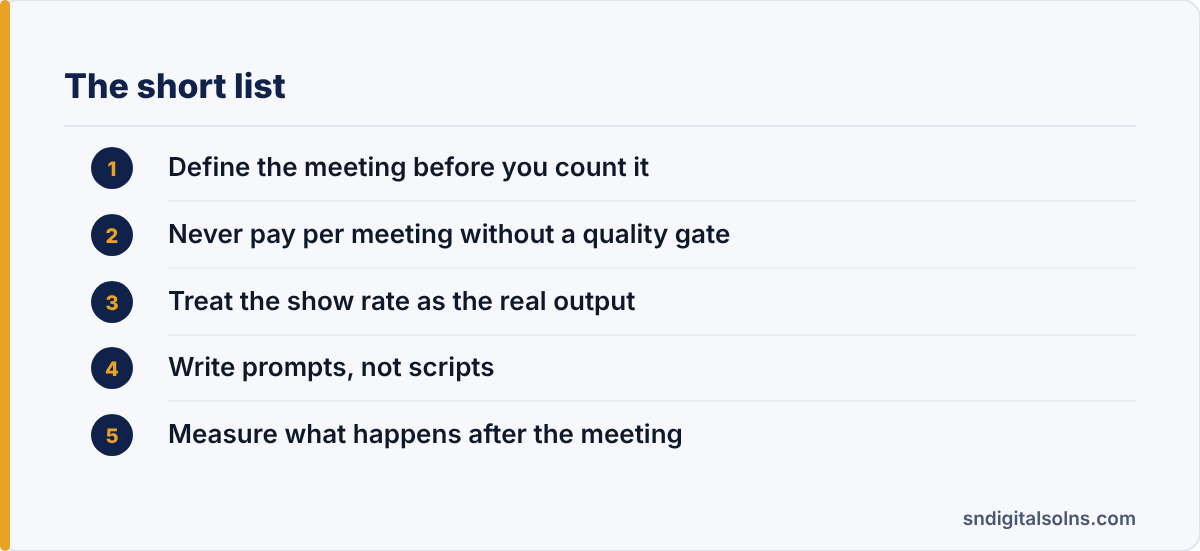
3. Treat the show rate as the real output
Between twenty and forty per cent of booked meetings do not happen, and that range is where the economics of appointment setting are decided. A programme booking thirty meetings at a sixty per cent show rate is beaten by one booking twenty at ninety.
So invest in the gap: a confirmation the same day, a reminder the morning of, a calendar invitation that says what will be covered, and a named human to reschedule with. These are unglamorous and they move the number more than any script change.
4. Write prompts, not scripts
An appointment setting script read aloud is audible within two sentences and ends the call. However the opposite, sending people in with nothing, produces wildly inconsistent qualification and no way to improve.
Instead give them the three questions that must be answered, the two disqualifiers that end the call politely, and the one sentence that explains what you do. In short, structure the judgement and leave the words alone.
5. Measure what happens after the meeting
Appointment setting is nearly always reported on meetings booked, because that is the number the activity produces directly. Nevertheless the figure that decides whether the programme survives is opportunities created per hundred meetings held, measured a quarter later.
Track it from the first month even when the sample is small. Teams that start measuring only once the channel is questioned have no history to defend it with, and the programme is usually cut while it was working.
When appointment setting is the wrong investment
If your close rate on inbound meetings is already poor, more meetings will not help and will hide the real problem. If your market is a few hundred accounts, a founder doing it personally will outperform any programme. And if nobody can state the qualification bar, start there rather than hiring.
For a sense of the ratios involved, our four LinkedIn outbound accounts turned 1,086 replies into 370 booked sales calls.
For reference on who you are actually allowed to call in the US, the FTC’s Telemarketing Sales Rule guidance is the plain-language source. Our B2B lead generation service covers the pipeline around it, and how to spot a real lead generation company is worth reading before outsourcing.