
Picking a nearshore software development company is usually a decision about time zones that turns out to be a decision about communication. The pitch is simple enough: similar working hours, lower cost than hiring locally, easier to reach than a team twelve hours away. All of that can be true, and none of it is the thing that decides whether the project works.
We build software and we also buy it, so we have been on both sides of the nearshore software development company question. Here is what we would want settled first.
1. A nearshore software development company’s overlapping hours only help if someone uses them
Four shared hours a day is the usual selling point, and it is genuinely valuable. However, it only pays off if those hours are spent on decisions rather than status updates. A daily call where someone reads out a task board is not collaboration, it is a report delivered expensively.
So ask how the overlap is actually used, and ask who is expected to be in it on your side. A nearshore software development company stalls for the same reason local ones do, which is that a question sat unanswered for a day.
2. Cost is the weakest reason to hire a nearshore software development company
If the only argument is the rate, the maths usually disappoints. Rework, longer ramp-up and the management time you now spend coordinating all eat the difference. The strong arguments are different: you can start in weeks rather than months, you can scale back down without a redundancy process, and you get specialists you could not justify hiring full time.
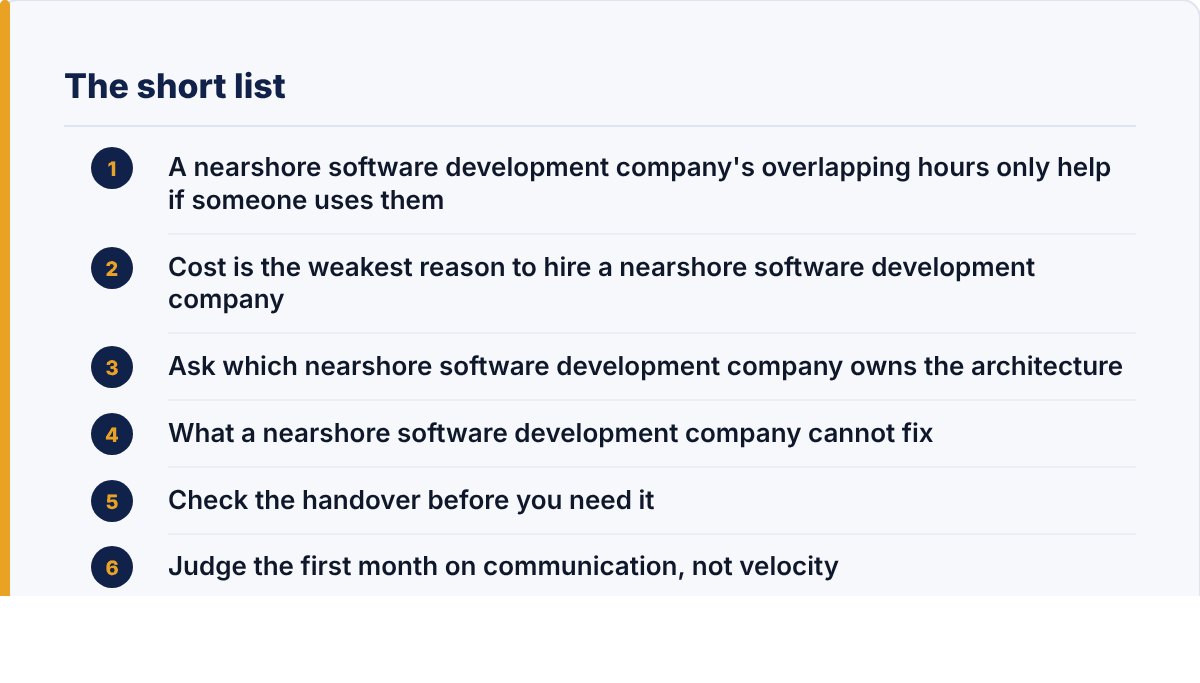
3. Ask which nearshore software development company owns the architecture
This is where projects quietly go wrong. If the vendor owns every architectural decision and you own none, then you have bought a black box that only they can maintain. If you own all of them and they own none, you have bought typists.
The workable answer is usually that they propose and you approve, with the reasoning written down somewhere you can read later. Ask to see a decision record from another project.
4. What a nearshore software development company cannot fix
It cannot decide what the product should do. Unclear requirements do not become clear by being sent abroad, and in fact distance makes vague specifications more expensive, because the gap between what you meant and what was built takes longer to surface.
So if the brief is still forming, pay for a short discovery phase before the build. It feels like a delay and it is almost always cheaper than the alternative.
5. Check the handover before you need it
Ask what you receive if the engagement ends badly. Repository access, infrastructure credentials, documentation, build instructions, and the right to the code in writing. Agree it at the start, because nobody negotiates this well once the relationship has soured.
Then test it once, early. Have your own developer clone the repository and run the project from the written instructions. If that takes a week, you have found something worth knowing while it is still cheap.
6. Judge the first month on communication, not velocity
Early velocity numbers tell you almost nothing, since the team is still learning your domain. What tells you a great deal is how they behave when something is unclear. Do they ask, or do they guess and carry on? Do problems arrive early and small, or late and large?
For the contractual side of all this, the World Intellectual Property Organization’s notes on software and intellectual property are a reasonable neutral starting point before your lawyer sees the agreement.
What people ask us about nearshore software development
How is a nearshore software development company different from an offshore one?
Distance, and therefore working hours. A nearshore software development company sits within a few hours of your time zone, so questions get answered the same day. Offshore is cheaper per hour and slower per decision, and which of those costs you more depends entirely on how settled your requirements are.
What size team should a nearshore software development company start with?
Smaller than you expect. Two or three engineers and a lead for the first six weeks is enough to prove the working relationship, and scaling a team that already communicates well is far easier than fixing a large one that does not.
Who owns the code a nearshore software development company writes?
You should, in writing, from day one, with repository and infrastructure access in your own accounts rather than theirs. This is cheap to agree at the start and close to impossible to agree at the end.
The short version
A nearshore software development company works when you already know what you want built and need capable hands in roughly your working day. It struggles when it is used to outsource the thinking, because that is the one thing distance makes harder rather than easier.
If you want to see how we run a build, our custom software development page sets out the sequence, and our approach page explains how we handle the decisions you will be asked to make.