

Sanjan Sharma · Founder & Director
Sanjan Sharma is an entrepreneur and technology and digital growth professional with 8+ years of experience across digital marketing, technology, SaaS, education, BFSI, banking, B2B sales and business growth.
Most outbound lead generation budgets are spent before a single message is written, in the decision about who to contact. That decision is usually made quickly, by whoever exported the list, and it quietly determines almost everything that follows.
These six fixes address where the waste actually sits, rather than where it is usually looked for.
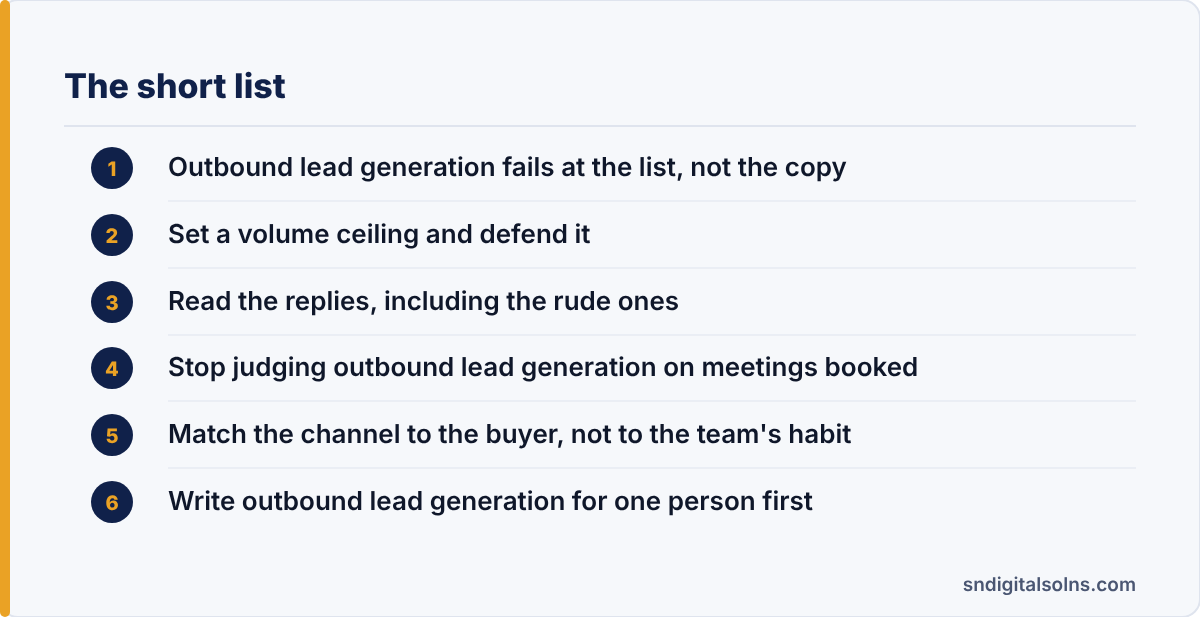
1. Outbound lead generation fails at the list, not the copy
Teams rewrite subject lines for weeks while sending to a list nobody interrogated. However a perfect message to the wrong five hundred people produces nothing, and an ordinary message to the right fifty produces conversations.
So spend the first week building a named account list with a stated reason each account is on it. Moreover, write the disqualifiers down, because a list defined only by what qualifies grows until it means nothing.
2. Set a volume ceiling and defend it
Every outbound lead generation programme is tempted to raise daily volume when the numbers are soft. It works for about three weeks, and then the deliverability falls, the reply rate halves and the domain carries the damage for months.
Therefore set the ceiling at the start, when nobody is under pressure, and treat it as fixed. Consequently the only lever left is relevance, which is the lever you wanted people pulling anyway.
3. Read the replies, including the rude ones
In outbound lead generation, negative replies are the cheapest market research available and almost nobody reads them. They tell you which claim sounded arrogant, which assumption was wrong and which segment you have misread entirely.
So have one person read every reply weekly for the first quarter. In short, an outbound lead generation programme that only reviews positive replies is grading its own homework.
4. Stop judging outbound lead generation on meetings booked
Meetings booked is the easiest outbound lead generation number to move and the least informative. A programme can double it in a fortnight by lowering the bar, and the damage shows up a quarter later when the sales team stops trusting the source.
Instead measure opportunities created per hundred conversations, and track it from the first month even when the sample is small. Because the figure takes a quarter to mature, teams that start measuring only when the channel is questioned have nothing to defend it with.
5. Match the channel to the buyer, not to the team’s habit
Outbound lead generation has three channels and they reach different people. Senior operators in heavy industry answer the phone and ignore LinkedIn. Software buyers do the reverse. Nevertheless most outbound lead generation runs whichever channel the team already knows.
Test two channels against the same account list for six weeks and let the reply rates decide. It is the one test that pays for itself immediately.
6. Write outbound lead generation for one person first
The usual order is backwards: build a template, then personalise a line. Write instead to one real prospect you know well, then ask which parts could be true of fifty others. What survives that is your sequence, and the rest was filler.
Furthermore, this keeps outbound lead generation honest about research effort. If a message takes twenty minutes to make true, your volume ceiling is lower than you hoped, and knowing that early is cheaper than learning it from a spam complaint.
What good looks like after ninety days
Good outbound lead generation at ninety days looks like this: a list you can defend account by account, a stable reply rate, a qualification bar your own reps accept, and a first cohort of opportunities old enough to judge. Not a record month.
For the ratios involved, our four LinkedIn outbound accounts turned 5,076 invitations into 1,255 connections, 1,086 replies and 370 booked sales calls.
On the rules for commercial email in the US, the FTC’s CAN-SPAM compliance guide is the primary source. Our B2B lead generation service runs the programme end to end, and what to ask a cold email agency covers the same ground for email specifically.