

Sanjan Sharma · Founder & Director
Sanjan Sharma is an entrepreneur and technology and digital growth professional with 8+ years of experience across digital marketing, technology, SaaS, education, BFSI, banking, B2B sales and business growth.
Oil and gas marketing has a problem most sectors would envy and few would know what to do with: the total number of buyers is small enough to list. A few hundred operators, a few thousand decision makers, and contracts large enough that winning one changes your year. Marketing built on reach is the wrong instrument entirely.
What oil and gas marketing has to achieve instead is being known, approved and credible with a named set of people, long before a tender appears. Four rules follow from that.
1. Name the buyers, then market to exactly those
If your addressable market is three hundred companies, the sensible first step in oil and gas marketing is to write them down: operator, service company, EPC contractor, whoever actually signs. Then identify the three or four roles inside each one that matter, which is usually some combination of engineering, procurement, HSE and the asset manager.
Everything after that is cheaper and more honest than broad campaigning. You know who you are trying to reach, you can tell whether you have reached them, and you stop paying to be seen by people who will never buy.
2. Oil and gas marketing starts with qualification
In this sector the real gate is vendor qualification, not persuasion. Supplier registration, HSE record, insurance, certifications, financial standing and sometimes a site audit decide whether you can be considered at all. Plenty of good companies lose work they were perfectly capable of doing because the paperwork was not in place when the tender opened.
Treat qualification as a marketing activity rather than an administrative one, because it is the single thing most likely to disqualify you, and it has a lead time measured in months.
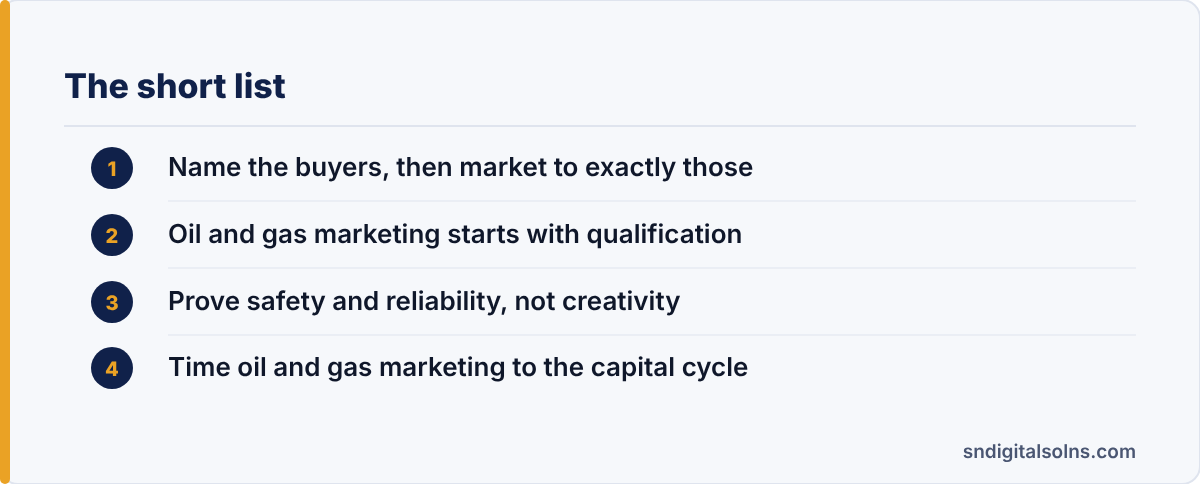
3. Prove safety and reliability, not creativity
Nothing in oil and gas marketing persuades like evidence of not causing problems. Uptime, incident record, on-time delivery, how a failure was handled. Buyers in this sector are managing risk on assets where mistakes are expensive and occasionally fatal, and they read your marketing with that in mind.
Which means the marketing that works looks dull by other sectors’ standards: technical specifications, case notes written for engineers, certifications with their scope stated, and references from people doing similar work on similar assets. The United States Energy Information Administration’s petroleum and other liquids data is the kind of source worth citing when you write about market conditions, because your readers already know the numbers and will notice if yours are invented.
4. Time oil and gas marketing to the capital cycle
Spending in this sector moves with commodity prices, final investment decisions and turnaround schedules, none of which care about your campaign calendar. Marketing hard into a downturn wastes money; being absent when budgets reopen costs far more.
The practical approach is steady presence with the named list through the cycle, and intensity timed to events that actually release budget: a sanctioned project, a scheduled turnaround, a new operator taking over an asset. That timing is public information if you watch for it, and almost nobody does.
Measuring oil and gas marketing honestly
Lead counts are close to meaningless when the buyer universe is this small. Track coverage of the named list, how many of those companies you are qualified with, how many of the right roles you have actually spoken to, and tender invitations received. Invitations are the real conversion event: everything upstream exists to produce them.
If you want this run as a programme rather than a series of campaigns, our B2B lead generation service is built for cycles this long, and our note on telling a real lead generation company from a reseller is worth reading before appointing anyone.