

Sanjan Sharma · Founder & Director
Sanjan Sharma is an entrepreneur and technology and digital growth professional with 8+ years of experience across digital marketing, technology, SaaS, education, BFSI, banking, B2B sales and business growth.
Mortgage lead generation is unusual among marketing problems because the supply is enormous and the quality is terrible. You can buy a thousand leads this afternoon. Almost none of them will close, and the ones that do would probably have found you anyway. The difficulty is not getting leads. It is getting leads that are worth a loan officer’s time.
This is a working guide to mortgage lead generation: the three ways mortgage leads actually arrive, what each one really costs once you count the follow-up, and which of them compounds instead of resetting to zero every month.
1. The three sources, and what each one is really for
Nearly every mortgage lead generation programme is some mix of three things: buying leads from an aggregator, running paid advertising, and earning inbound enquiries through search and referral. They behave very differently, and the mistake most brokers make is treating them as interchangeable.
Bought leads
Aggregators sell the same enquiry to several lenders at once. The Consumer Financial Protection Bureau’s guidance for borrowers shopping for a mortgage is worth reading precisely because it describes the process from the other side of the form. That is the business model, not an abuse of it. The person who filled in that form is, within minutes, fielding calls from your competitors, and whoever dials first tends to win. Bought leads can work, but only with the staffing to call inside a few minutes and the discipline to drop the rest.
Treat the price per lead as the smallest part of the cost. The real expense is the loan officer hours spent on contacts who were never going to transact.
Paid advertising
Advertising gives you control that bought leads do not: your own landing page, your own qualifying questions, your own follow-up. It also stops the moment you stop paying, and mortgage keywords are among the most expensive in any advertising account because every lender is bidding on the same intent.
Advertising is best understood as rented demand. Useful, immediate, and gone when the invoice stops.
Inbound and referral
The third source is the slow one, and it is where mortgage lead generation stops being a purchase and starts being an asset: ranking for the questions borrowers ask, being the broker a realtor recommends, and being findable when someone searches your name after a recommendation. It takes months rather than days. It also does not reset to zero, and the enquiries arrive without a competitor already on the phone.
2. Why most mortgage lead generation underperforms
Three failures account for most of it, and none are about the lead source. Each one is a process problem that no amount of extra mortgage lead generation spend will solve.
Speed. Mortgage enquiries decay faster than almost any other category. A lead called within five minutes and the same lead called the next morning are not the same asset. If your follow-up is a queue someone works through in the afternoon, your cost per funded loan is far higher than your cost per lead suggests.
No qualification before the call. Asking two or three questions on the form, such as timeline, purchase or refinance, and rough credit band, costs you some volume and saves far more in wasted calls. Volume is the wrong number to optimise.
Nothing after the first no. A borrower who is six months from buying is not a dead lead. They are a lead with a date on it. Most mortgage lead generation treats them as a loss because there is nowhere to put them.
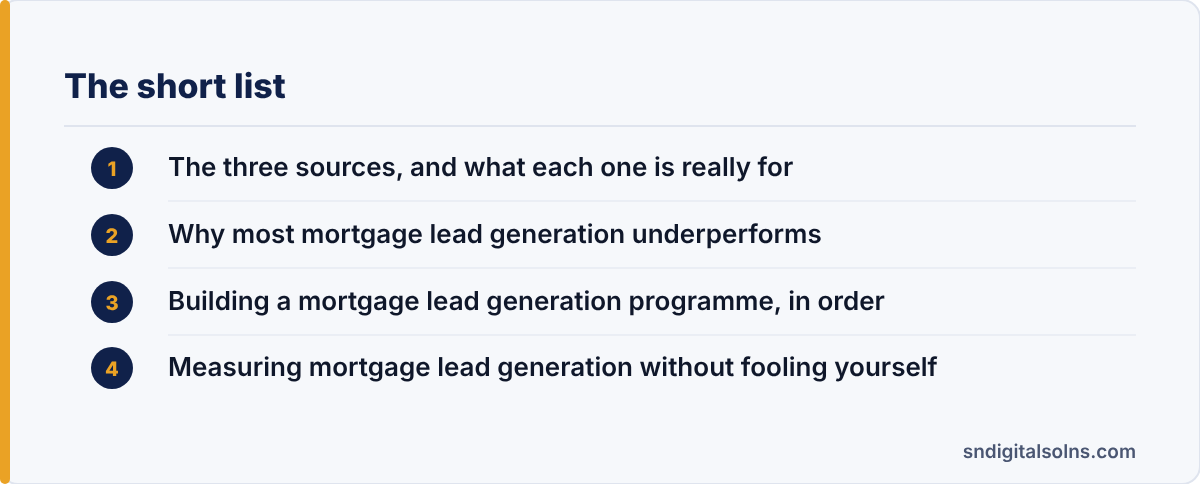
3. Building a mortgage lead generation programme, in order
If you are starting from very little, the order matters more than the tactics. See our B2B lead generation service for how we sequence this work.
First, make the follow-up fast. Before spending anything on new leads, fix the time between enquiry and first contact. This is free and it changes the economics of every other source.
Second, own your name and your area. Someone recommended to you will search for you. Your Google Business Profile, your reviews and your site should settle that search decisively. This is the cheapest mortgage lead generation available and it is routinely neglected. Our note on what separates a real lead generation company from a reseller covers the same ground for any firm selling in one city.
Third, answer the questions borrowers actually ask. Not “what is a mortgage”, which is answered everywhere, but the specific, local, awkward questions: self-employed documentation, what a particular programme requires, what happens when an appraisal comes in low. These rank because few lenders write them properly, and they attract people with a real situation rather than idle curiosity.
Fourth, build the referral side deliberately. Realtors, accountants and financial advisers already speak to your borrowers before you do. One reliable referral relationship frequently outperforms an entire month of bought leads.
Fifth, add paid advertising once the first four work. Advertising amplifies what already converts. Running it over a slow follow-up process is how brokers conclude that advertising does not work for mortgages.

4. Measuring mortgage lead generation without fooling yourself
Cost per lead is the number everyone reports and the least useful one. Track cost per funded loan by source instead, and accept that this takes a full loan cycle to become meaningful. Track speed to first contact, because it predicts more than any targeting change. And track what share of funded loans came from people who already knew your name, because that is the part that compounds.
None of this is exotic. Good mortgage lead generation is less about finding a better source than about being the lender who responds first, asks better questions, and is still there when the borrower is finally ready.