
Every business eventually gets the email: you have been shortlisted, the ceremony is in March, tables are available. Business rate awards occupy an odd space between genuine recognition and a paid marketing product, and the difference is not always visible from the invitation.
Here is how to tell them apart, and when entering is worth the effort.
1. Work out who pays for the business rate awards programme
Some awards are funded by entry fees, some by ticket sales, some by sponsors, and some by the winners buying logo licences afterwards. None of those is disqualifying on its own. However, if the revenue comes mostly from winners, expect a lot of winners.
A quick check: count last year’s categories. Forty categories with three winners each is a marketing product, whatever the branding says.
2. Read the business rate awards judging criteria before the entry form
Real business rate awards publish who judges, what they score, and how. Vague criteria usually mean the decision is editorial, which is fine if the publication matters to your buyers and worthless if it does not.
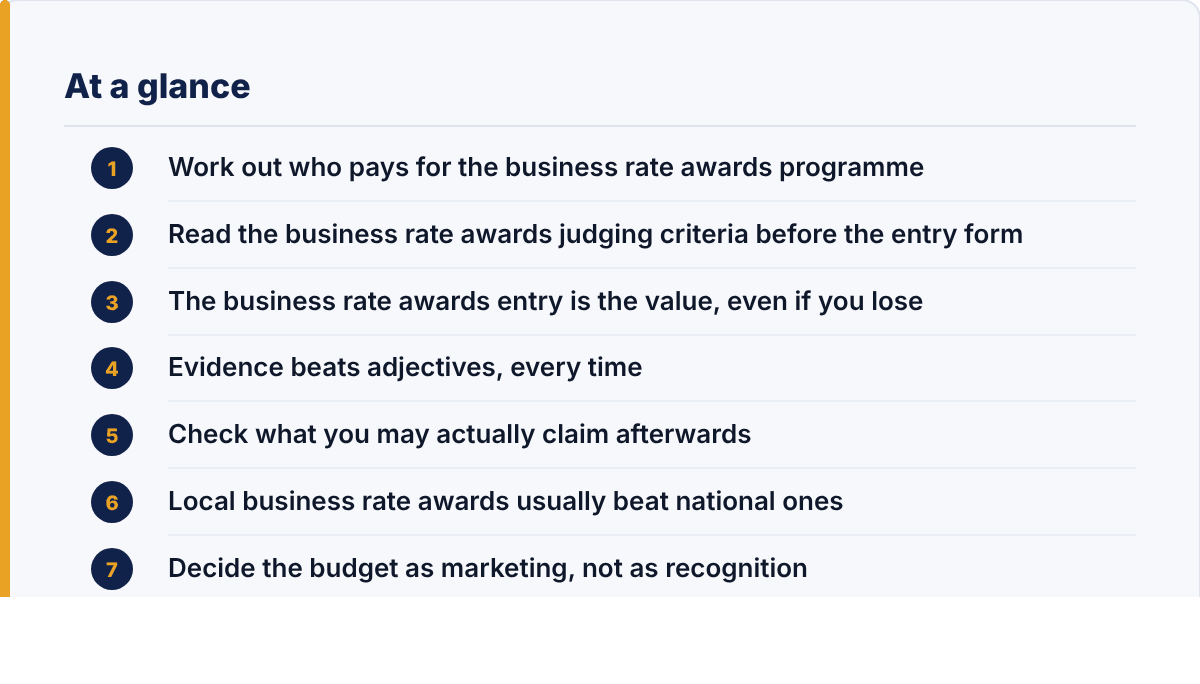
3. The business rate awards entry is the value, even if you lose
This is the part people miss. Writing a good entry forces you to state what you did, for whom, and what changed, with evidence. That document then feeds your website, your proposals and your case studies. Several of our strongest client write-ups started as award entries that did not win.
4. Evidence beats adjectives, every time
Judges read dozens of entries that all describe themselves as innovative and customer-focused. The ones that stand out contain specifics: what the situation was, what you changed, what the number did, and what you would do differently. Dashboard screenshots and client quotes do more than another paragraph of description.
5. Check what you may actually claim afterwards
Most programmes restrict how you use the logo, for how long, and whether finalists may call themselves anything. Beyond the programme’s own rules, how you describe an award in advertising is regulated, and the United States Federal Trade Commission’s advertising guide for small business is a clear summary of the line between confident and misleading.
6. Local business rate awards usually beat national ones
A regional or trade award your buyers recognise is worth more than a national badge nobody in your market has heard of. The reach is smaller and the credibility is specific, and specific credibility is what actually helps in a sales conversation.
7. Decide the budget as marketing, not as recognition
Business rate awards cost more than the entry fee: the time to write, the tickets, the travel and the logo licence add up quickly. Judge the whole figure against what else that money could do, because emotionally this is about recognition and financially it is a campaign.
When business rate awards are genuinely worth entering
Three conditions, roughly. Your buyers already know the name, the categories are few enough that winning means something, and you have a piece of work from the last year with evidence attached. Meet all three and the entry is a good use of a week. Meet one and it is a logo.
Business rate awards questions we get asked
Do business rate awards actually win work?
Indirectly. They rarely create an enquiry on their own, and they do shorten the trust conversation when a buyer already recognises the name. Treated as proof rather than promotion, business rate awards earn their place.
Is it worth paying to enter business rate awards?
Only where the name means something to your buyers and the categories are few. A fee for a programme with forty categories is advertising, which can still be a reasonable purchase as long as you budget it as one.
Who should write the business rate awards entry?
Whoever did the work, with an editor. Entries written entirely by marketing read as adjectives, and judges are reading for evidence.
A quick way to triage an invitation
Four questions. Who judges it, how many categories are there, what does winning cost in total, and would one of your buyers recognise the name unprompted? If the answers are unclear, unclear, large and no, then it is advertising, and you can judge it as such without feeling churlish.
If you want help writing the entries, our awards and recognition page covers how we approach them, and the digital PR page explains how a win becomes coverage rather than a logo in a footer.